Home / Blogs / IMSI in Male Infertility: A Closer Look ...
← All Blogs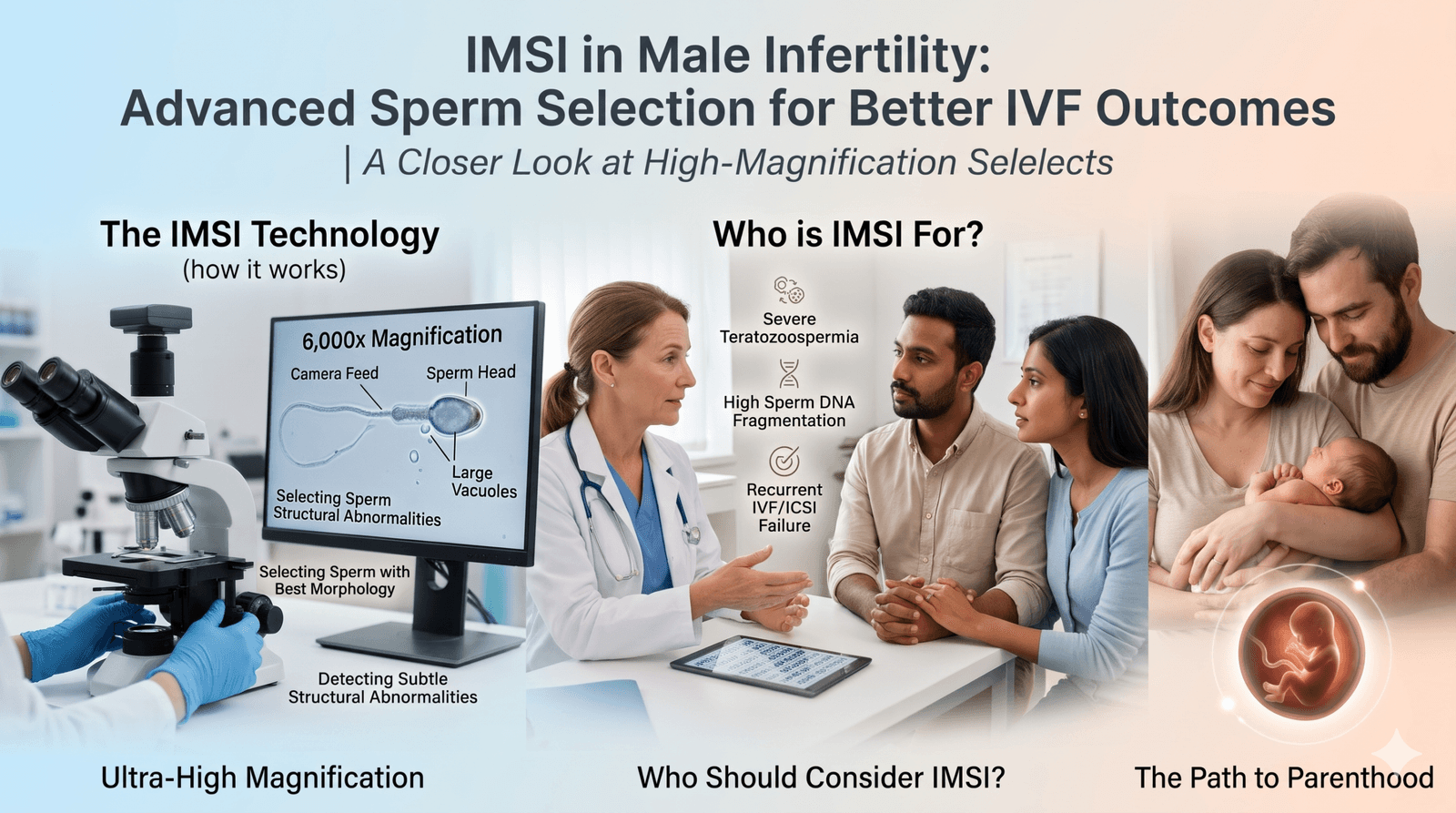
IMSI in Male Infertility: A Closer Look at Advanced Sperm Selection for Better IVF Outcomes
Introduction
Infertility is often viewed as a female health concern, but male factors contribute to nearly 40-50% of infertility cases. While conventional semen analysis helps assess sperm count, motility and morphology, some men continue to experience infertility despite seemingly normal test results.
This is where Intracytoplasmic Morphologically Selected Sperm Injection (IMSI) offers a more advanced approach. IMSI is a specialised fertility technique used during IVF treatment to help identify and select the healthiest sperm for fertilisation. For couples who have experienced repeated IVF failures, poor embryo quality or severe male factor infertility, IMSI may improve the chances of achieving a successful pregnancy.
Understanding IMSI, when it is recommended and how it can benefit fertility treatment can help couples make informed decisions during their parenthood journey.
What Is IMSI?
Intracytoplasmic Morphologically Selected Sperm Injection (IMSI) is an advanced form of ICSI (Intracytoplasmic Sperm Injection) used in assisted reproductive technology.
In a standard ICSI procedure, embryologists select a sperm using a microscope that magnifies approximately 200 to 400 times. With IMSI, the sperm is examined under a highly powerful microscope with magnification of up to 6,000 times or more, allowing embryologists to identify subtle structural abnormalities that cannot be detected during conventional sperm selection.
Once the healthiest sperm is identified, it is injected directly into the egg, similar to the ICSI procedure.
The goal of IMSI is simple:
- Select sperm with the best morphology
- Reduce the risk of using sperm with hidden defects
- Improve fertilisation rates
- Improve embryo development
- Potentially increase implantation and pregnancy rates
How Does IMSI Help Male Infertility?
Sperm that appear normal under conventional microscopes may sometimes have structural abnormalities that affect fertilisation and embryo development.
IMSI enables embryologists to detect:
- Abnormal sperm head shape
- Large vacuoles within the sperm nucleus
- Chromatin defects
- Structural abnormalities linked to DNA damage
By selecting sperm with superior morphology, IMSI aims to improve the quality of embryos created during IVF treatment.
Which Male Infertility Conditions May Benefit from IMSI?
Your fertility specialist may recommend IMSI if you have:
Severe Teratozoospermia
A condition where a high percentage of sperm have abnormal shapes.
High Sperm DNA Fragmentation
Damaged sperm DNA may affect embryo development and pregnancy outcomes.
Recurrent IVF or ICSI Failure
Couples who have undergone multiple unsuccessful treatment cycles may benefit from more precise sperm selection.
Poor Embryo Quality
If embryos repeatedly stop developing or show poor growth, sperm quality may be contributing to the problem.
Recurrent Miscarriages
In some cases, poor sperm quality or DNA damage may contribute to repeated pregnancy loss.
Unexplained Infertility
When standard fertility investigations fail to identify a clear cause, IMSI may offer additional support during treatment.
How Is Male Infertility Diagnosed Before IMSI?
Before recommending IMSI, fertility specialists perform several diagnostic tests.
Semen Analysis
The first-line investigation evaluates:
- Sperm count
- Motility (movement)
- Morphology (shape)
- Volume
Advanced Sperm Testing
Sperm DNA Fragmentation Test
Measures DNA damage within sperm cells.
Hormonal Assessment
Doctors may evaluate:
- FSH
- LH
- Testosterone
- Prolactin
Genetic Testing
Recommended in selected cases of severe male infertility.
Scrotal Ultrasound
Used to identify:
- Varicocele
- Testicular abnormalities
- Obstructions
A complete fertility evaluation helps determine whether IMSI is likely to improve treatment outcomes.
Can You Identify Male Fertility Problems Yourself?
Many men do not experience obvious symptoms of infertility. However, certain signs may indicate the need for evaluation:
- Difficulty conceiving after 12 months of regular unprotected intercourse
- Low sperm count on previous testing
- History of varicocele
- Prior testicular surgery or injury
- Erectile or ejaculation difficulties
- Hormonal symptoms such as low libido
- Previous failed IVF or ICSI cycles
It is important to note that many men with infertility have no visible symptoms. Professional fertility testing remains the most reliable way to assess reproductive health.
Questions to Ask Your Fertility Doctor About IMSI
Being informed can help you make confident treatment decisions.
Consider asking:
- Am I a suitable candidate for IMSI?
- What is causing my male infertility?
- Have my sperm morphology and DNA fragmentation been evaluated?
- How does IMSI differ from standard ICSI in my case?
- What are the expected benefits for our fertility treatment?
- Does current evidence support IMSI for my diagnosis?
- Are there additional tests I should undergo before treatment?
- What are the success rates at your fertility centre?
- Will IMSI increase treatment costs?
- Are there alternative approaches that may be equally effective?
Recent Research and Clinical Findings
Current research suggests that IMSI may provide advantages in carefully selected patients with severe male factor infertility.
Several studies have reported:
- Improved sperm selection accuracy
- Better embryo quality
- Higher implantation rates in selected patients
- Reduced miscarriage rates in some groups
- Potential benefits for couples with repeated IVF failure
However, research findings remain mixed. While some studies demonstrate improved reproductive outcomes, others report similar pregnancy rates when comparing IMSI with conventional ICSI.
Most fertility experts agree that IMSI may be particularly helpful for specific male infertility conditions rather than all IVF patients.
How Is IMSI Performed?
The IMSI procedure follows the same general steps as IVF and ICSI.
Step 1: Ovarian Stimulation
Eggs are stimulated and retrieved from the female partner.
Step 2: Sperm Collection
A semen sample is collected and processed.
Step 3: Advanced Sperm Selection
Using ultra-high magnification, embryologists carefully identify sperm with the most favourable morphology.
Step 4: Sperm Injection
The selected sperm is injected directly into the mature egg.
Step 5: Embryo Development
Fertilised eggs are monitored in the laboratory before embryo transfer.
Can Male Fertility Be Improved Before IMSI?
Yes. Many lifestyle and medical interventions may support sperm health.
Healthy Lifestyle Habits
- Maintain a healthy weight
- Exercise regularly
- Stop smoking
- Limit alcohol intake
- Manage stress
- Improve sleep quality
Nutritional Support
Foods rich in:
- Zinc
- Selenium
- Coenzyme Q10
- Vitamin C
- Vitamin E
- Omega-3 fatty acids
may support sperm health.
Medical Treatment
Depending on diagnosis, treatment may include:
- Hormonal therapy
- Varicocele repair
- Management of infections
- Antioxidant supplementation
Treating underlying causes can improve natural fertility and assisted reproductive outcomes.
Advantages of IMSI
Potential Benefits
More detailed sperm assessment
Improved sperm selection
May improve embryo development
May benefit severe male infertility cases
May help after repeated IVF or ICSI failures
Potential reduction in sperm-related fertilisation issues
Limitations of IMSI
Possible Drawbacks
Longer laboratory procedure
Increased treatment costs
Not necessary for every IVF patient
Research findings remain mixed
Success is not guaranteed
Pregnancy depends on multiple male and female factors
Frequently Asked Questions (FAQs)
Is IMSI the same as ICSI?
No. IMSI is an advanced version of ICSI that uses significantly higher magnification to select sperm with superior morphology before injection.
Who should consider IMSI?
Men with severe sperm morphology issues, high sperm DNA fragmentation, repeated IVF or ICSI failure, poor embryo quality or recurrent pregnancy loss may benefit from IMSI.
Does IMSI improve IVF success rates?
IMSI may improve outcomes in selected patients, particularly those with significant male factor infertility. Results vary between individuals.
Is IMSI painful?
No. IMSI is a laboratory procedure performed on collected sperm and eggs. It causes no additional discomfort to the male partner.
Can IMSI treat male infertility?
IMSI does not cure male infertility. Instead, it helps embryologists select the best available sperm during IVF treatment.
Is IMSI better than conventional IVF?
For certain male infertility diagnoses, IMSI may provide additional benefits. Your fertility specialist can determine whether it is appropriate for your case.
How much extra time does IMSI take?
Sperm selection under very high magnification requires additional laboratory time compared with standard ICSI procedures.
When Should You Consider IMSI?
You may wish to discuss IMSI with your fertility specialist if:
- You have severe male factor infertility.
- Multiple IVF or ICSI cycles have failed.
- Sperm morphology is significantly abnormal.
- DNA fragmentation levels are elevated.
- Embryo quality has been consistently poor.
- Recurrent miscarriages remain unexplained.
A personalised evaluation is essential to determine whether IMSI is likely to improve your fertility outcomes.
Facing infertility can feel overwhelming, especially when repeated treatments do not bring the results you hope for. Male infertility is more common than many people realise, and seeking specialised evaluation is an important step towards finding answers.
As an IVF counsellor, I encourage couples to explore all evidence-based treatment options available to them. IMSI may offer additional support for selected patients facing male factor infertility, but every fertility journey is unique. Understanding your diagnosis, asking the right questions and working closely with an experienced fertility team can help you make informed decisions with confidence and hope.
If you would like guidance on male infertility, IVF treatment options, sperm health or advanced fertility procedures such as IMSI, professional counselling can help you navigate your treatment journey with clarity and emotional support.
Medical Disclaimer
This article is intended for educational and informational purposes only and should not be considered medical advice, diagnosis or treatment. IMSI is a specialised laboratory technique used in selected IVF cases and may not be suitable for every patient. Treatment recommendations should always be based on an individual evaluation by a qualified fertility specialist or reproductive endocrinologist. Success rates vary depending on age, fertility diagnosis, sperm quality, egg quality and other clinical factor.